Two things decide whether a custom beach ball matches the picture in your head: the size you actually receive after inflation, and how cleanly your artwork lands on a curved, seamed surface. Both are easy to get wrong from a product listing alone, and both are locked in the moment you approve a proof. This walkthrough covers what to specify, in the order a printer needs it, so the balls that arrive look the way you expected.
The good news is that beach balls are a forgiving, low-cost promotional item once you understand the handful of variables that matter. Get the size, the imprint panel, and the color count right, and the rest is routine.
The size on the listing is not the size you will hold
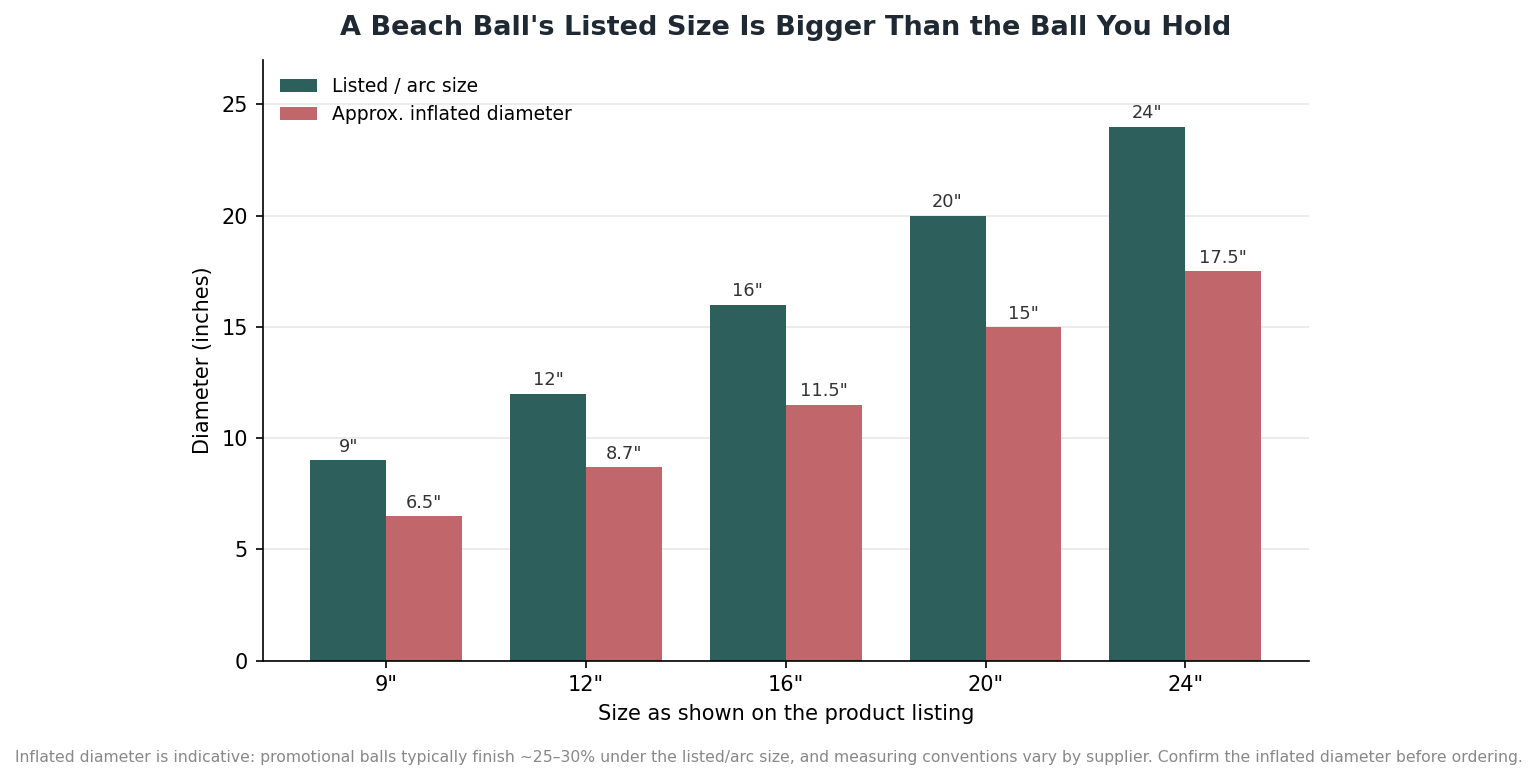
Beach balls are almost always listed by their deflated or arc size, measured pole to pole across the curve of a laid-flat ball, which is roughly half the circumference. That number is meaningfully larger than the diameter of the inflated sphere. Material has to be shaped so a flat disc inflates into a round ball rather than an egg, and the ball also never inflates to a perfect drum, so the finished diameter runs about 25 to 30 percent under the listed figure.
In practice, a 20-inch listing inflates to roughly a 15-inch diameter, and a 24-inch ball finishes around 17 to 18 inches across. A 16-inch ball, the most common promotional size, holds at somewhere near 11 to 12 inches. Conventions are not standardized across suppliers, so the single most useful thing you can do is ask for the inflated diameter and specify the ball by that number, not by the headline size. If a ball is going in a gift bag or a mailer, that distinction is the difference between a snug fit and a return.
The imprint panel is smaller than the ball
A standard beach ball is built from six tapering panels that meet at the top and bottom valves. Most promotional balls alternate colors and leave one panel white to carry the imprint. That white panel, not the whole ball, is your canvas, and it is smaller than people expect. On a 16-inch ball a typical single-panel screen imprint runs about 5 inches wide by 3 inches high, and the usable area narrows toward the poles as the panel tapers.
Because the surface is curved and the panels are seamed, fine detail suffers. Bold vector shapes and thick lines reproduce cleanly; small text, thin rules, and tight gradients do not. Keep the logo centered in the panel with margin around the seams so nothing critical rides the edge where registration drifts. If you need artwork on more than one panel, or a design that wraps the whole ball, say so up front, because it changes both the tooling and the price.
One color or full color: match your artwork to the method
Screen printing is the default and the reason beach balls are cheap. It lays down solid spot colors panel by panel, with one color usually included in the base price and each additional color adding its own screen and setup charge, indicatively in the range of 40 to 65 dollars per color. Spot colors should be specified as Pantone (PMS) references and supplied as vector art in AI, EPS, or PDF format so the printer can pull clean separations. Two or three flat colors is the sweet spot for cost and legibility.
When a design needs photographic imagery, blends, or many colors, some suppliers offer full-panel or full-wrap digital printing instead. It reproduces gradients and detail that screen printing cannot, but it comes from fewer factories, usually carries a higher minimum, and costs more per unit. If your brand lives on a photograph or a complex gradient, price the digital route early; if it is a clean two-color logo, screen printing will almost always be the better value.
What actually drives the price: quantity, setup, and lead time
Unit price on beach balls is dominated by volume. Minimums commonly sit around 150 to 250 pieces, and the per-ball cost falls steadily from there. A 16-inch, one-color ball that runs near 1.30 dollars at a couple hundred units drops toward roughly a dollar past a thousand, and into the 80-cent range at the largest quantities. Those figures are indicative published pricing from one U.S. supplier and will vary, but the shape of the curve is consistent across the industry.
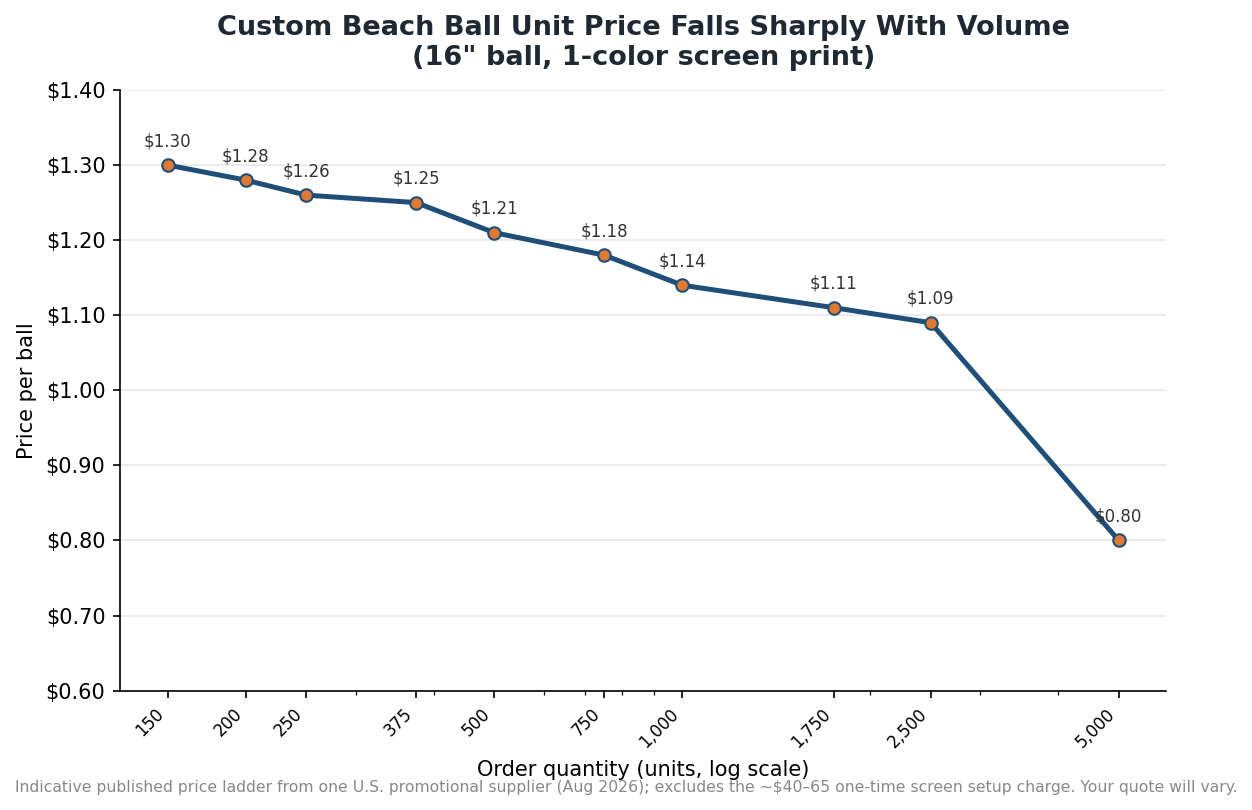
Two costs sit on top of that ladder. The screen setup charge is a one-time fee per color, so a second or third color is cheap spread across 2,000 balls and expensive across 200. And lead time is its own variable: bare production can be as fast as a few business days, but realistic timelines run one to two weeks plus transit once art approval and shipping are counted. Rush service exists at a premium. If the balls are for a dated event, build in a proof cycle and a shipping buffer rather than ordering against the factory’s fastest quoted number.
Material and safety details worth confirming
Nearly all promotional beach balls are made from PVC, valued for being light, cheap, weldable into clean seams, and easy to print. If the balls will be handled by or marketed to children under 12, the relevant issue is phthalate content and CPSIA testing. Phthalate-free PVC is widely available in this category, but it is worth asking a supplier to confirm the specific compound and any children’s-product testing rather than assuming it. For an adult trade-show giveaway the distinction matters less; for a kids’ event or a retail-bound premium it can be a compliance requirement.
Thickness is the other quiet quality signal. Thicker-gauge PVC feels more substantial and resists seam failure, while the lightest balls trade durability for price. Suppliers rarely publish an exact gauge, so if longevity matters, ask for a sample before committing to a large run.
Put together, a clean order specifies five things: the inflated diameter you actually want, a bold vector logo sized to a single white panel, a realistic color count in Pantone spot colors, a quantity chosen with the setup fee in mind, and a timeline that includes proofing and shipping. Nail those, and a custom beach ball is one of the most reliable low-cost promotional items you can buy.