A beach ball is soft PVC, and soft PVC is exactly the material U.S. toy-safety law was written to police. That single fact should change how you buy custom beach balls, because a product most people think of as a throwaway giveaway can legally be a children’s toy, subject to phthalate limits, lead limits, testing, and certification. Getting this right is not paperwork for its own sake; it is what stands between a clean shipment and a customs hold, a recall, or a liability problem. Here is what the rules actually require and what to confirm before you place an order.
When a promotional beach ball counts as a children’s product
Under the Consumer Product Safety Improvement Act, the strict rules apply to children’s products, meaning items designed or intended primarily for children 12 and younger. The Consumer Product Safety Commission decides that by weighing how the product is marketed and packaged, whether it is commonly recognized as being for children, and its physical characteristics. A beach ball sits in an awkward spot: it is often bought by adults for adult events, yet it is also a classic children’s toy, so a plain, brightly colored ball can easily be treated as a children’s product no matter who you had in mind. Branding it for a nightclub or a trade-show booth does not automatically move it out of scope. The safe working assumption is that your beach ball will be judged a children’s toy unless you have a documented, defensible basis that it is a general-use product, and even then many retailers and buyers now expect toy-grade compliance across the board.
Phthalates: the 0.1% rule that targets soft vinyl
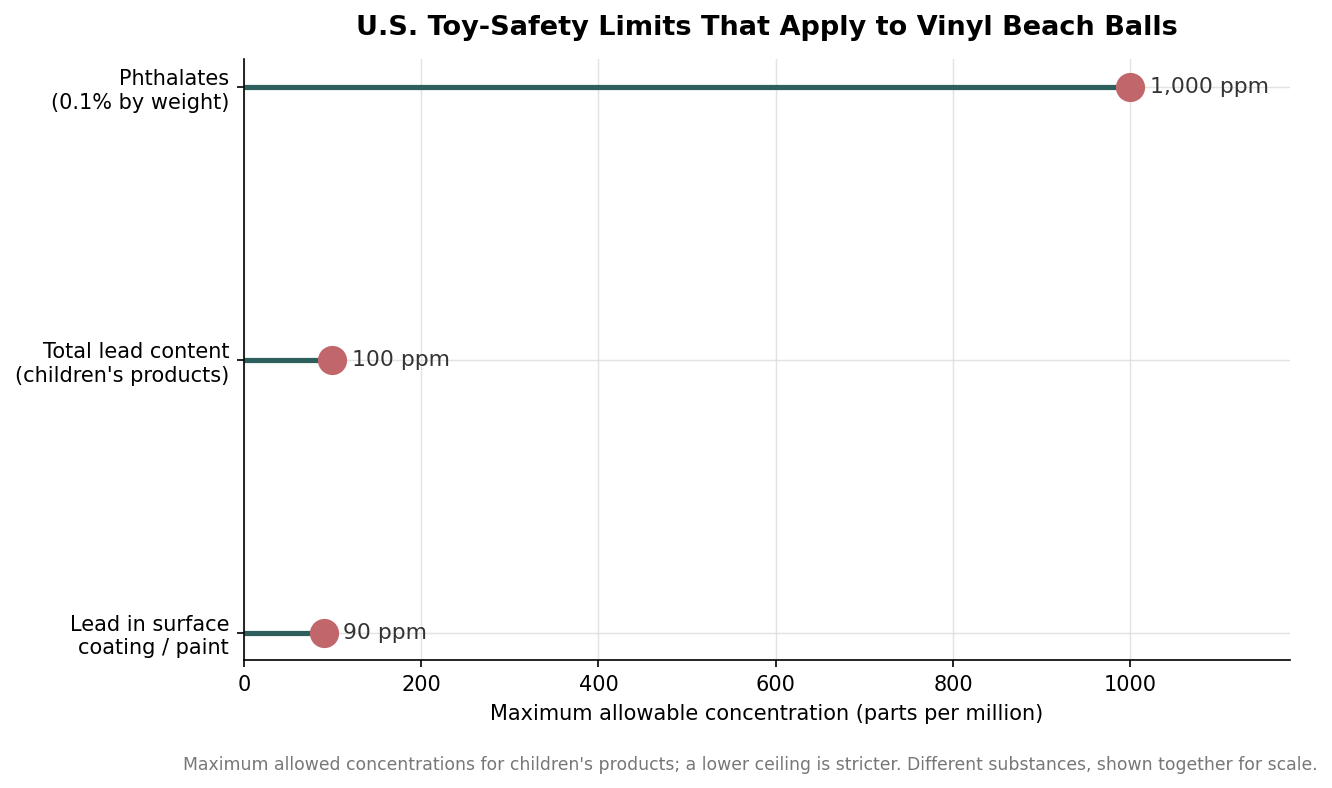
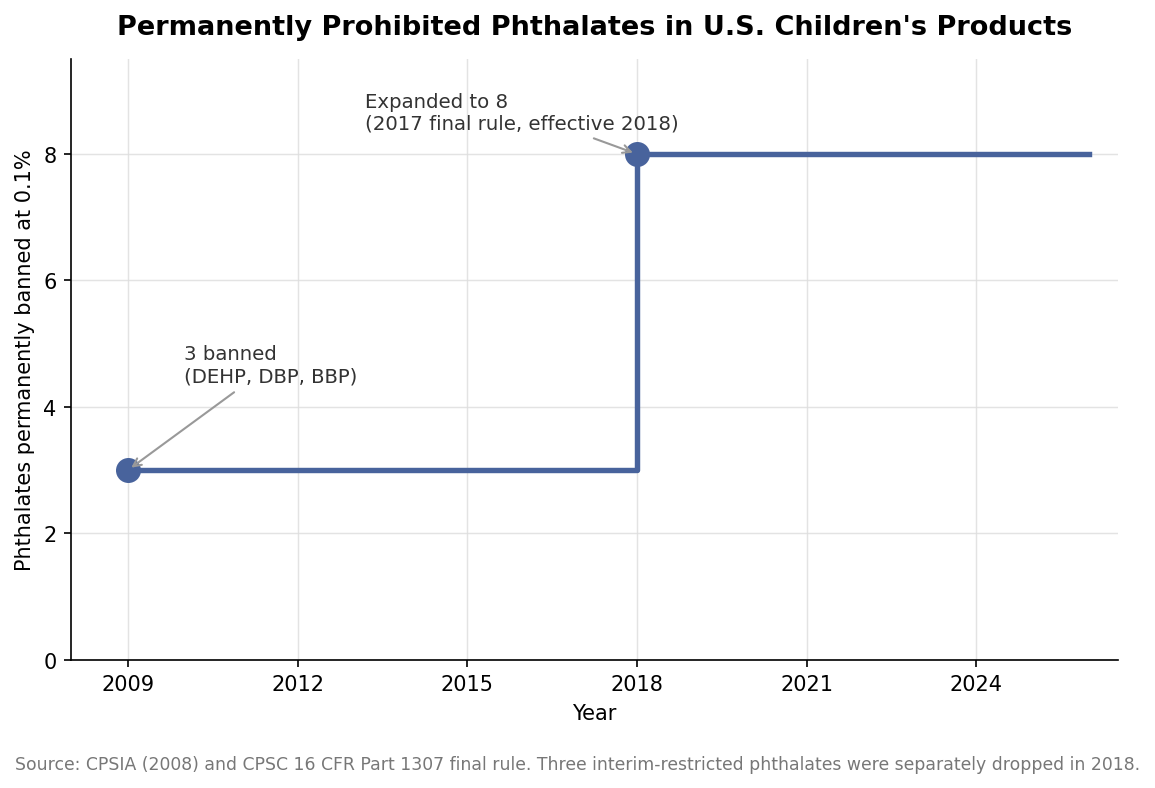
Phthalates are the plasticizers that make rigid PVC soft and flexible, which is the very property that makes a beach ball a beach ball. Federal law, at 16 CFR Part 1307, prohibits eight phthalates, DEHP, DBP, BBP, DINP, DIBP, DPENP, DHEXP, and DCHP, above 0.1% by weight, or 1,000 parts per million, in children’s toys and child care articles. Because a beach ball is essentially a thin, phthalate-plasticized film, this is the requirement most likely to trip up a low-cost import. Compliant suppliers use phthalate-free plasticizers such as DOTP, a terephthalate, or citrate-based plasticizers instead, so ask specifically which plasticizer the vinyl uses rather than accepting a generic non-toxic claim. There is one narrow relief: the ban applies to accessible material, so a component that is genuinely enclosed and never exposed through normal use, aging, or breakage falls outside it. That exception rarely helps with a single-wall inflatable, where practically all of the material is accessible.
Lead, ASTM F963, and the rest of the package
Phthalates are one line on a longer list. Children’s products must also meet lead limits: no more than 100 ppm total lead content in the substrate, and no more than 90 ppm lead in any surface coating or paint, which is the category that covers the inks printed on the ball. Toys intended for children under 14 must comply with ASTM F963, the mandatory U.S. toy-safety standard, which addresses mechanical and physical hazards, small parts, and related risks. Compliance is not self-declared. A children’s product generally must be tested by a CPSC-accepted third-party laboratory, names such as Bureau Veritas, Intertek, SGS, Eurofins, and QIMA, and be covered by a Children’s Product Certificate that lists each rule tested against and the lab that performed the work. The finished goods also need a tracking label so a specific unit can be traced back to its production run. If a supplier cannot produce a current certificate and test reports for the exact material and inks on your order, you do not have documented compliance, whatever the price sheet claims.
Selling into the EU or to children’s brands
If any of the stock will cross into Europe, a parallel regime applies. Toys sold in the EU need CE marking and must meet the EN 71 safety standard, and the REACH regulation restricts phthalates in a similar way, so a U.S.-compliant ball is not automatically EU-compliant, and the reverse is equally true. Retailers, schools, and family-brand clients frequently layer their own testing and documentation demands on top of the legal minimum, sometimes requiring total-phthalate or heavy-metal panels that go beyond the federal list. Treat those buyer requirements as part of the specification from the start, because retrofitting compliance onto an order already in production is both expensive and slow.
What to put in your order and ask your supplier
Turn all of this into a short, concrete checklist that travels with your artwork. State that the material must be phthalate-free to the CPSIA 0.1% limit, and name an acceptable plasticizer if you have a preference; require lead compliance at 100 ppm in the substrate and 90 ppm in the printed inks; ask for a current Children’s Product Certificate and the underlying third-party test reports for the specific vinyl and inks; and confirm that finished goods will carry a compliant tracking label. Ask when the referenced testing was performed, because a certificate should reflect the material actually being run, not a years-old sample of a different formulation. None of this needs to slow a capable supplier down, since reputable promotional-product factories handle it routinely, but the buyer who asks in writing, before production, is the one who ends up with clean paperwork instead of a surprise at the border.
The reason to care is straightforward: a beach ball is soft vinyl printed with ink, which is precisely the profile that toy-safety law scrutinizes most closely. Assume the children’s-product rules apply, get the phthalate and lead compliance documented in writing, and keep the certificate and test reports on file. That turns an open compliance question into a settled one, and it protects the brand whose logo is riding on every ball.