Custom beach balls are one of the cheapest, most cheerful promotional items you can order, which is exactly why they are easy to get wrong. The mistakes are rarely about taste; they are about a handful of technical details that do not show up until the box arrives or the ball is in a child’s hands. Here are the errors that most often turn a fun giveaway into a disappointment, and how to avoid each one before you place the order.
Mistake 1: Ordering by the label size
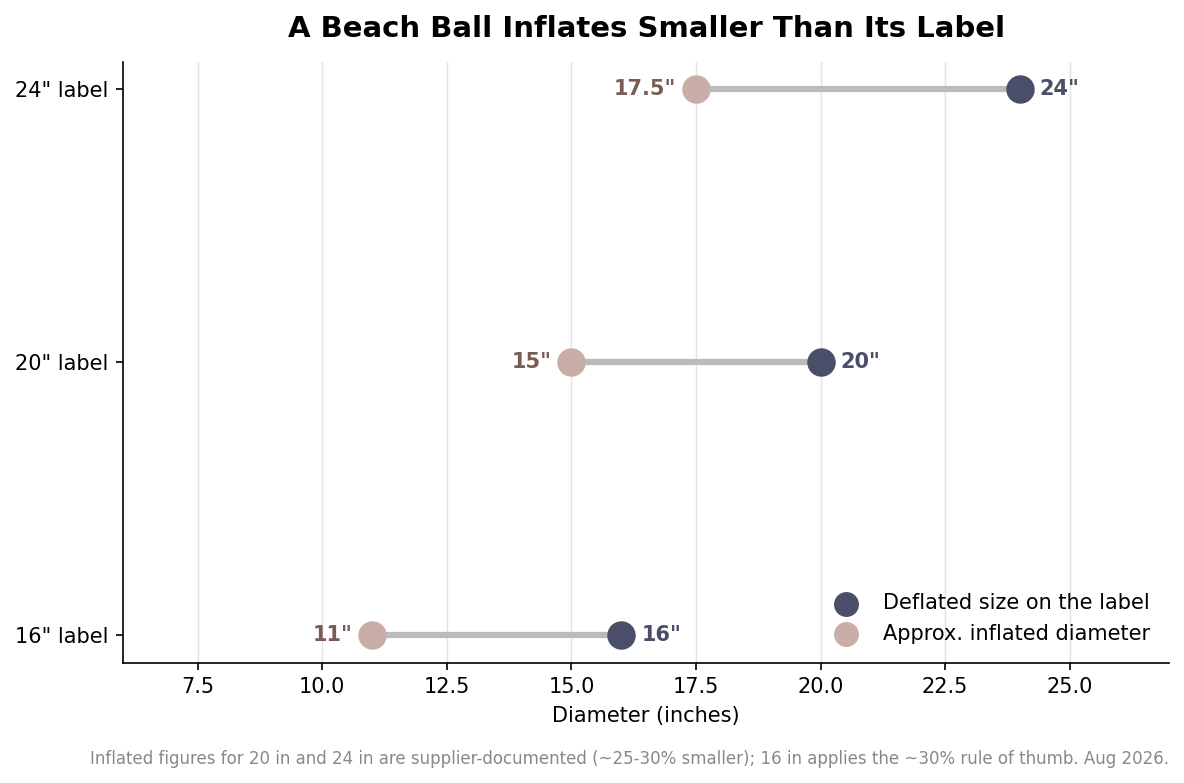
The number on a beach ball listing is almost always the deflated size, which is the flat length of the panels before the ball is assembled and blown up. It is not the diameter you will hold in your hands. As a ball goes from its long, flat form to a sphere, and as length is trimmed at each end so it inflates round instead of egg-shaped, it loses roughly a quarter to a third of that labeled figure. A ball listed at 20 inches inflates to about 15 inches across, and a 24-inch ball lands around 17 to 18 inches. Scale that up and an “8-foot” giant stands closer to 6 feet.
The fix is simple: buy on the inflated diameter, not the label. Ask the supplier what the ball actually measures when inflated, and picture that number in the setting where it will be used. A 16-inch label that arrives at roughly 11 inches is fine for a pool giveaway and underwhelming as a stage-toss crowd ball. Confirming the inflated size is the single easiest way to avoid opening the box to something smaller than you pictured.
Thickness matters as much as size. Beach ball vinyl is sold in different gauges, and a thin, bargain wall punctures and creases far sooner than a slightly heavier one. You cannot always see the difference in a photo, so ask about the material weight and, where you can, handle a sample. For a single-use pool toss the lightest option may be fine, but for anything that gets repeated play or has to survive shipping and storage, a sturdier wall is worth the small premium.
Mistake 2: Designing artwork that fights the ball
A beach ball is a curved surface divided into panels with seams between them, and artwork that ignores that geometry prints badly. The most common error is packing a logo with fine detail, small text, or thin lines, all of which distort as the panel curves and stretches. The second is spreading a design so it has to wrap across a seam, where registration is never perfect and the image breaks. Photographic or gradient-heavy art is a poor match for the screen printing typically used on vinyl.
Design for the medium instead. Bold vector artwork with thick lines and one or two solid colors reproduces cleanly and reads from across a pool or a trade show floor. Center the main mark on a single panel so it sits clear of the seams, and size text up rather than down. If your brand mark is intricate, simplify it to a high-contrast version for this product rather than shrinking the full logo. The goal is legibility on a moving, curved, glossy object, which is a very different target than a flat printed page.
Keep the color count honest, too. Each additional screen-printed color adds a setup and a registration step, and on a curved, seamed surface every extra color is another chance for slight misalignment. A clean two-color design that nails registration looks more professional than a four-color one that drifts, and it usually costs less per ball. If your identity really needs more colors, that is a signal to consider a full-wrap printed ball rather than spot-color screen printing, and to price both before deciding.
Mistake 3: Forgetting that a beach ball can be a regulated toy
This is the mistake with real consequences. In the United States, a product that is designed or intended primarily for children 12 and under is treated as a children’s product, and a beach ball meant for kids is a toy under that framework. That pulls it under the CPSIA and the ASTM F963 toy-safety standard, which means limits on lead, a cap of 0.1 percent on specified phthalates in the vinyl, third-party testing by a CPSC-accepted lab, and a tracking label on the product. Ordinary flexible PVC can contain the very phthalates those rules restrict, so “it’s just a beach ball” is not a safe assumption.
The practical step is to tell your supplier up front how the ball will be used. A ball handed to adults at a conference sits in a different regulatory place than one marketed to families or given to children, and a supplier who makes compliant product will know to specify phthalate-free PVC and provide the testing and labeling that children’s products require. If children are anywhere near the audience, put compliance in the conversation before you put art on the ball. This is general product-safety information rather than legal advice, so confirm the specifics for your situation.
Mistake 4: Leaving the order too late for the season
Beach balls are seasonal, and the same summer weeks that make them useful also crowd the production calendar. Screen printing on vinyl involves finalizing artwork, approving a proof, running the print, and shipping, and each step takes real time. Ordering a week before an outdoor event leaves no room for a proof revision or a shipping delay, and rush service, where available, costs more and still has limits.
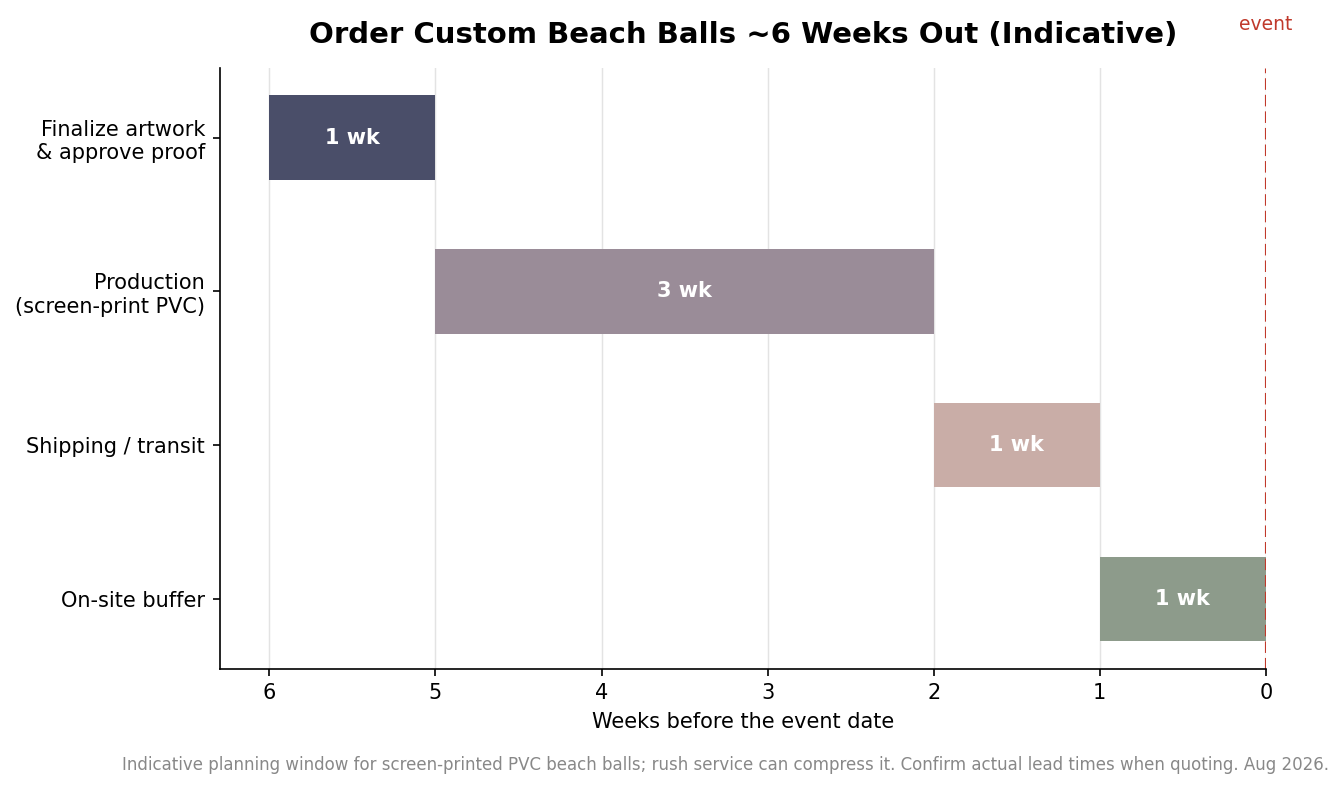
A comfortable rule of thumb is to start about six weeks out: roughly a week to lock artwork and approve the proof, a couple of weeks or so for production, a week for transit, and a week of buffer before the date. Treat those spans as indicative and confirm the real lead time when you request a quote, because it varies by supplier, quantity, and season. The buffer matters most: it is the week that absorbs a re-proof or a carrier delay without putting your event at risk. Order early enough and the only thing left to worry about is whether you bought enough of them.