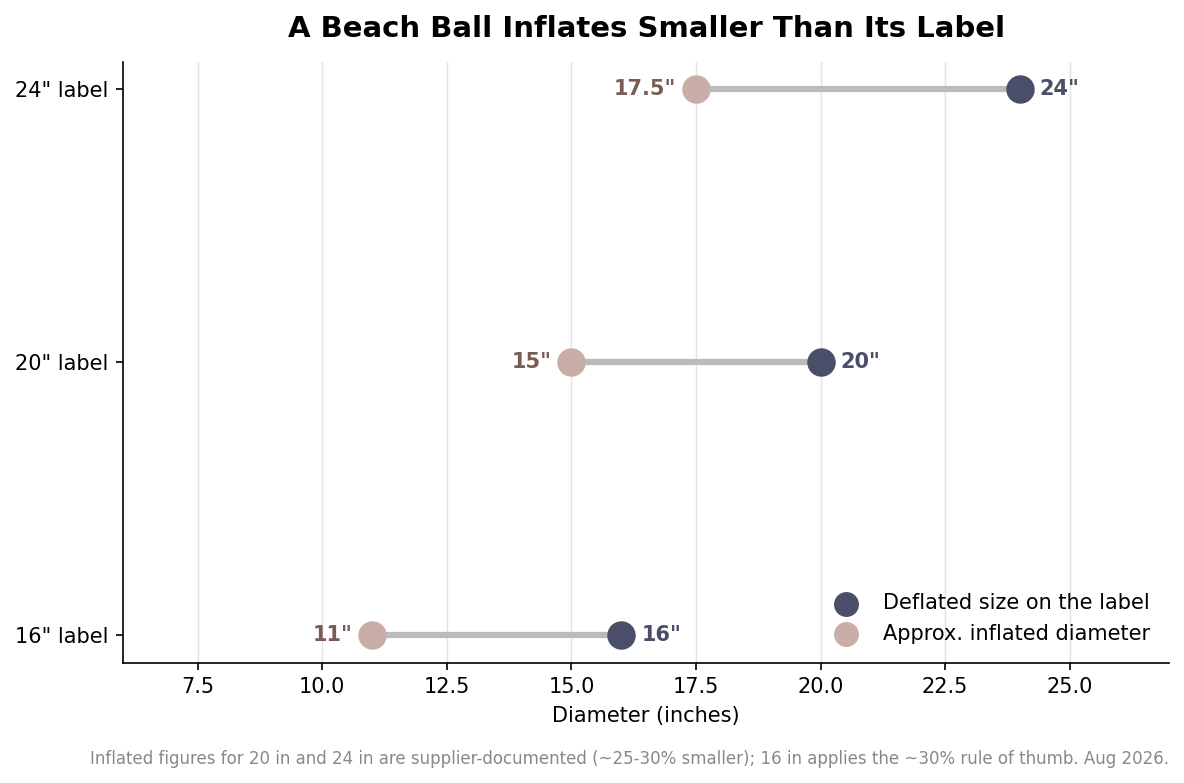
The most common surprise in a first beach ball order has nothing to do with color or artwork. It is the size. A buyer orders a “16-inch” ball, pictures something the size of a basketball, and opens the box to find an inflated toy closer to 11 inches across. Nothing went wrong. Beach balls are almost universally listed by their deflated size, and the number on the listing is not the diameter you will hold in your hand. Getting this one convention right prevents the single most frequent ordering regret.
The number on the listing is the flat, deflated size
A beach ball is made from flat vinyl panels welded together. When the industry quotes a “16-inch ball,” that measurement refers to the panel dimension while the ball lies flat, not the diameter once it is inflated and round. There are two physical reasons the inflated ball comes out smaller. First, manufacturers deliberately shorten the panels toward their ends during assembly, so that when the ball fills with air it pulls into a proper sphere instead of an elongated, egg-shaped blob. Second, more length is lost in the geometry of turning a long flattened shape into a round one. The practical result is a consistent rule of thumb: an inflated beach ball measures roughly 70 percent of its listed deflated size, give or take. Sellers’ own examples bear this out — a 20-inch ball inflates to about 15 inches, and a 24-inch ball to roughly 17 to 18 inches.
What each size actually becomes
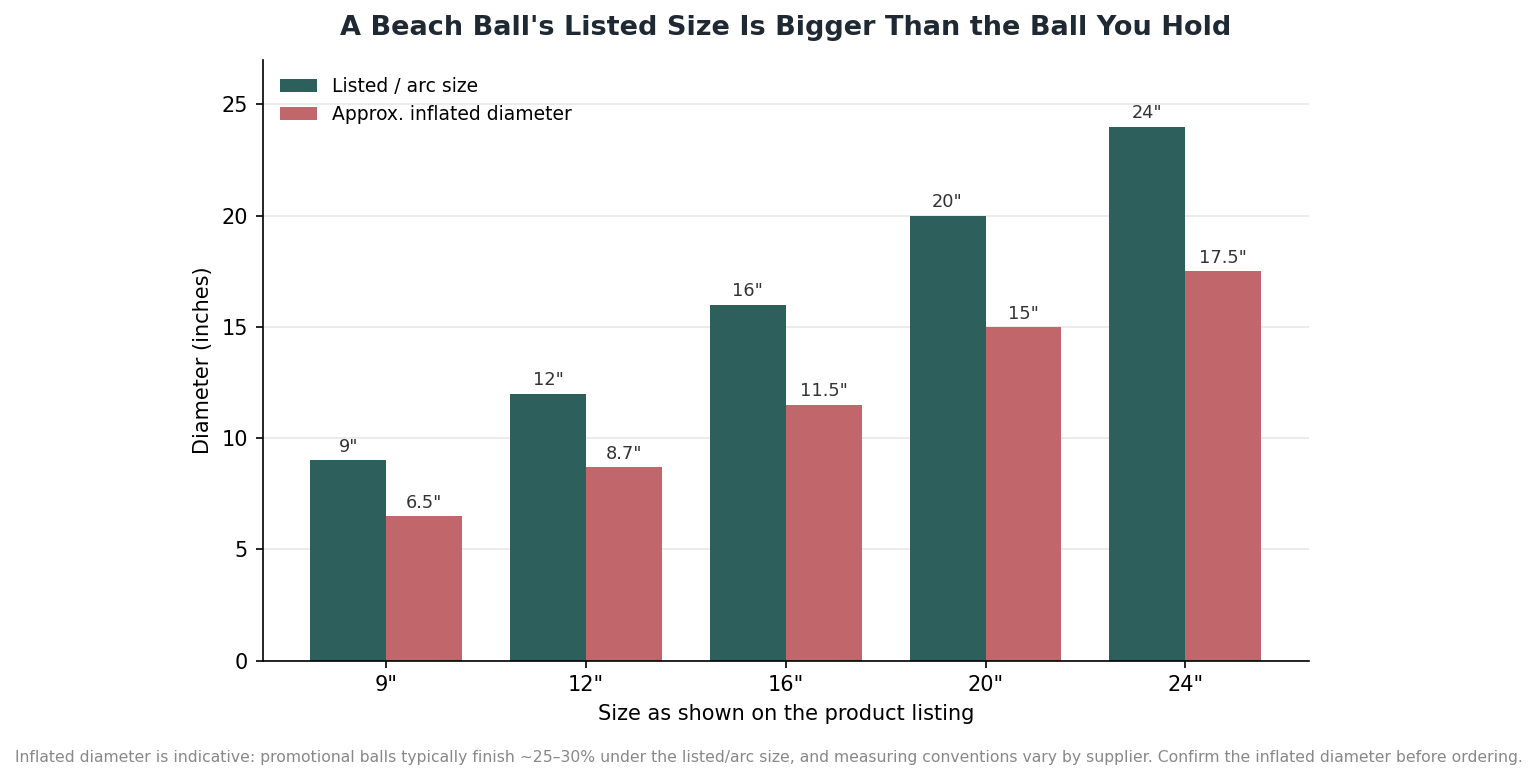
Applying that rule across the common sizes turns the catalog numbers into something you can actually plan around. The chart below pairs each listed size with its approximate inflated diameter.
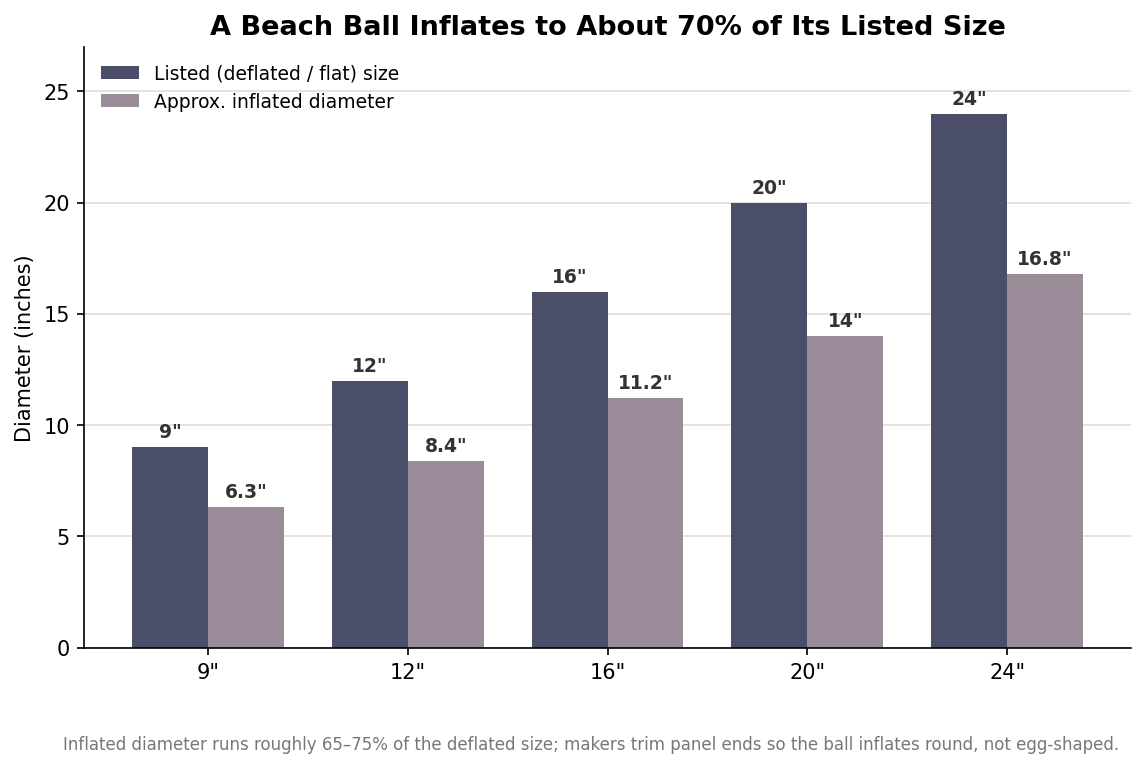
Read from the right side of each pair, the sizes suddenly make sense for real use. A 9-inch ball is a pocket-sized giveaway barely six inches across when full. A 12-inch ball inflates to around eight and a half inches, still firmly a small promotional toy. The popular 16-inch ball lands near 11 inches inflated — a comfortable, tossable size that reads well in a crowd without being unwieldy. Step up to 20 and 24 inches and you get the roughly 14- to 18-inch balls people picture for photo ops and beach activations. When you compare quotes or pick a size, translate every deflated number to about 70 percent before deciding, and if a supplier lists an inflated diameter directly, use that.
Panels, seams, and where the logo goes
Most promotional beach balls are built from six panels, and that construction shapes your branding options more than any other single factor. Printing is typically done panel by panel, and artwork is usually placed within a panel rather than across a seam, because a design that crosses the welded seam distorts and can crack at the join. The number of panels you print determines how much of the ball carries your message, and it scales cleanly: a single printed panel covers about a sixth of the surface, two or three alternating panels cover roughly a third to a half, and printing all six delivers a full wrap. The chart below shows that progression.
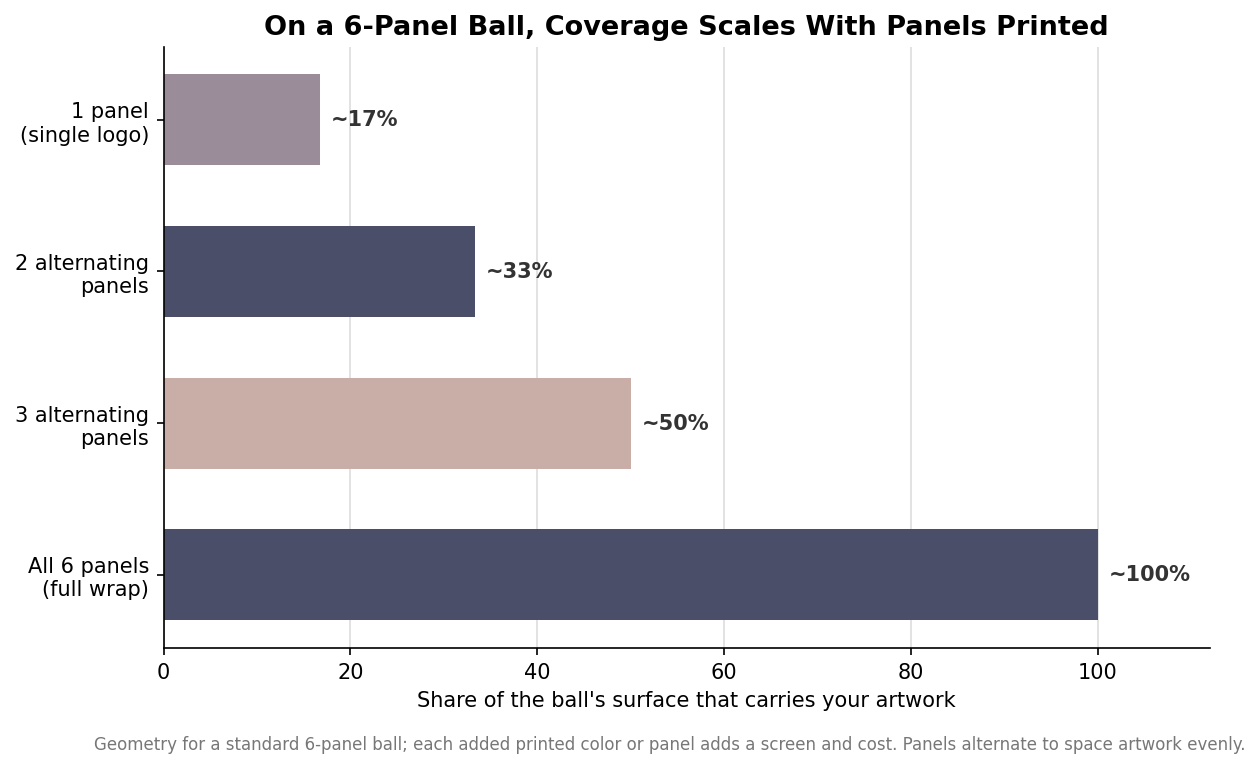
Coverage is also a cost lever. Each additional printed panel and each additional ink color generally means another screen and another setup, so a one-panel, one-color logo is the economical baseline and a full-color, all-panel wrap sits at the premium end. Alternating the printed panels — rather than clustering them on one side — keeps the artwork visible as the ball tumbles, which is usually what a crowd-toss giveaway actually needs.
Choosing the size for the job
Work backward from where the ball will live. For tabletop giveaways, kids’ packs, and anything that has to fit in a swag bag, the 9- to 12-inch deflated sizes are right; they inflate small, ship compact, and cost the least per unit. For general promotions — festival tosses, pool days, broad giveaways — the 16-inch size is the sensible default, large enough to be seen and caught but still easy to carry and store deflated. When the goal is a photo moment, a stage prop, or a high-visibility beach activation, move up to the 20- to 24-inch range, accepting the higher price and bulk in exchange for presence. Match the inflated size, not the label, to the mental picture you have of the event.
Storage and handoff logistics quietly favor the smaller end too. Because balls ship and store flat, a case of deflated 12-inch balls takes almost no room and stays giveaway-ready until an event, whereas oversized balls demand a pump and a few minutes of inflation each, which adds up fast when a booth needs dozens ready at once. If your team will be inflating on site, factor in that time and plan for a small percentage of duds; if the balls are being mailed to recipients to inflate themselves, the compact deflated form is a genuine advantage. None of this changes the artwork, but it changes how smoothly the promotion runs on the day, so weigh it alongside size and coverage rather than treating it as an afterthought.
A word on material and print method
Beach balls are made from PVC vinyl, and for anything that could reach children the material specification matters as much as the size: reputable promotional balls are produced from phthalate-free vinyl to meet U.S. safety expectations for items handled by kids. That compliance question deserves its own attention before you order, especially for family-facing events. On the printing side, screen printing is the standard for durable, multi-color logos on the larger sizes, while smaller balls may be pad printed. All of the figures here — the 70 percent inflation rule, the panel coverage percentages, the size-to-use guidance — are indicative and vary a little by manufacturer and construction, so use them to shortlist a size and coverage plan, then confirm the exact inflated diameter and imprint area on a proof or spec sheet before you commit to a run.